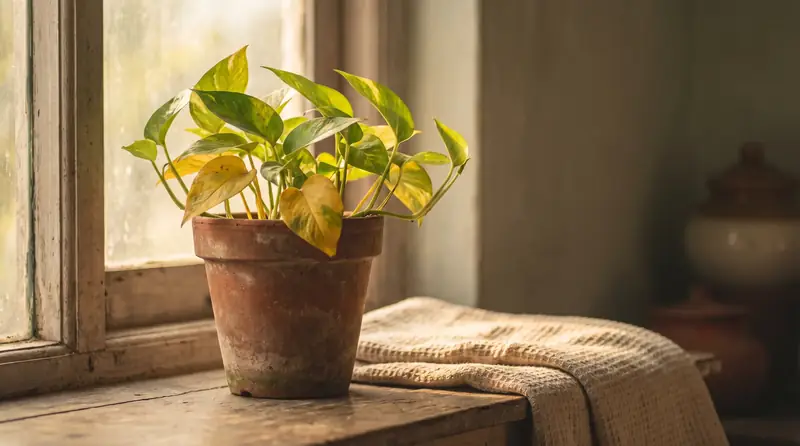
Every week, without fail, we get the same message. Usually on WhatsApp, usually with a slightly out-of-focus photo, usually at night. "My money plant is turning yellow — am I overwatering it?"
The answer is almost never yes.
In years of running this nursery, I've watched thousands of money plants ("Pothos," if you want to be formal about it) come through our gates. Beautiful, vining, surprisingly dramatic plants. And I've learned that yellow leaves are like a headache — a symptom with at least eight possible causes. Before you reach for the watering can (or worse, decide to skip watering for two weeks), work through this list.
The diagnostic: five questions
Stand in front of the plant. Look at it properly — not just the yellow leaf, but the whole plant. Then answer these five questions honestly. No defensiveness.
Which leaves are yellow?
If it's the oldest leaves at the base, relax. That's natural. If it's the newest leaves at the tips, worry. That's a problem.
How does the soil feel?
Stick a finger in, two knuckles deep. Wet and smelly is overwatering. Bone dry for weeks is the opposite. Slightly damp is correct.
When did you last repot?
If the answer is "never" or "more than 2 years", that's probably your answer. A root-bound plant can't feed itself.
How much light does it actually get?
Money plants tolerate low light but don't thrive there. Three feet from a window is the sweet spot — not six, not twelve.
Root cause #1: it's the roots
Seriously. In our experience, about 40% of yellow-leaf complaints in money plants come down to the root system — and specifically, to the pot being too small.
Money plants are vigorous. The top grows, but the bottom grows faster. In a nursery setting, we re-pot most of our stock every 14-18 months. In a home setting, most people re-pot… never. Here's the test: lift the plant gently from its pot. If you see a dense ball of circling white roots, you're overdue. By a lot.
The two-inch rule
When repotting, go up only 2 inches in pot diameter. Bigger is not better — an oversized pot holds too much water, and your roots will rot. We say this every day. Nobody listens. Please listen.
Root cause #2: the light is lying to you
People think their flat is "bright enough." It is not. Our eyes are excellent — they adjust to low light so well that a room feels fine to us while it's starving a plant of photosynthesis.
Here's a quick test: at noon, on a sunny day, stand where your plant stands. Can you read small print on a book without turning on a lamp? If yes, the plant is getting enough light. If no, it isn't. Yellow leaves — especially pale, floppy yellow leaves on long, stretched stems — are the plant telling you this.
We've had customers insist their plant gets "plenty of light." Then they send a photo, and we see it sitting in a bathroom. Three meters from the one frosted window.— Our head gardener, The team
The fix is not complicated. Move the plant closer to a window. East-facing is best for money plants — gentle morning sun, then bright indirect through the afternoon. Give it a week. Watch the new growth. It will thank you.
Root cause #3: chlorine and hard water
This is the one nobody talks about, and it's disproportionately common in Indian cities. Tap water in most of India is heavily chlorinated. Over months, the chlorine (and calcium, and fluoride) builds up in the soil and quietly starves the roots of nutrients.
Symptoms: leaves that turn yellow between the veins first, sometimes with crispy brown edges. The plant looks sick but the soil moisture is fine.
The fix — a 5-minute habit
- Fill a clean container with tap water.
- Leave it uncovered, overnight. Most of the chlorine will evaporate.
- Water your plants with that water the next morning.
- Every 2-3 months, flush the pot: take it to the sink, let water run through for 2 minutes. This leaches out built-up salts.
If you do nothing else, do this. We've watched plants recover within a month just from this single change.
Root cause #4: seasonal stress
India has no "gentle" season. Every month throws something at your plant — 44°C summers, 4°C winters, monsoons that last eight weeks, dry winds that last six. Money plants notice all of this. A yellowing leaf in mid-May in Delhi is usually the plant complaining about the dry air, not the watering.
The fix is seasonal, not universal. In summer: mist more, water less often but more deeply, move away from hot windows. In winter: reduce watering by 40%, stop fertilizing, keep away from AC and heaters.
Get a care calendar tuned to your city
Our members get a monthly care calendar timed to their pin code's actual weather — when to water more, when to repot, when to stop fertilizing. It's how we keep early members' plants healthier than the average Indian home plant. Join for ₹599.
When to actually worry
Most yellow leaves are fixable. But there are three signs you should take seriously:
- Black, mushy stems at soil level — root rot. Stop watering immediately, unpot the plant, cut away the rot, repot in fresh dry soil.
- White cottony patches on leaves — mealybugs. Wipe with neem oil on a cotton pad. Repeat weekly for three weeks.
- Yellow with dark spots that spread — fungal infection. Remove affected leaves, reduce watering, improve air circulation.
For anything else: breathe. Money plants are nearly indestructible. Give them bright indirect light, water them when the top inch of soil is dry, and repot them every 18 months. Do those three things and you'll have a plant for a decade.
And if you're still confused — send us a photo on WhatsApp. A real gardener will reply. Usually within four hours, typically within a day. Simple, straightforward support.